Health information careers
Explore medical records careers with a fictional record check
Compare three fictional clinic records, write a clarification note and find out what to check before choosing medical records or coding training in the US.
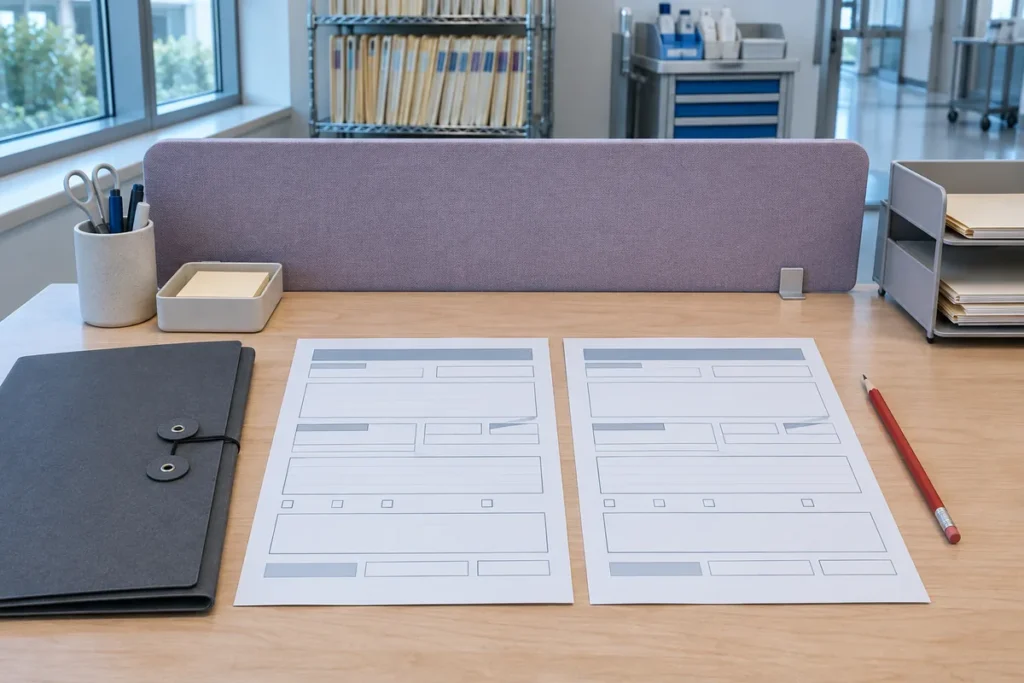
A visit appears on a clinic’s schedule. Later, a signed note arrives with a similar reference number. Can you tell whether the note belongs to that visit? What would you need to ask before someone relies on it?
That kind of question gives you a way to explore medical records work before choosing a course. This guide uses US occupation sources and a fictional exercise. You can try it with a pen and paper.
Look at what the team needs from the record
The US Bureau of Labor Statistics describes medical records specialists as checking records, maintaining electronic information and protecting confidentiality. Some of the work involves coding, which means using a classification system to represent information documented in a record. Staff may ask a clinician for clarification when the source is incomplete. Read the BLS overview of medical records work.
O*NET lists both records clerks and medical coders as examples of reported US job titles. A vacancy with one of these titles may spend more time on document completeness, coding or requests for records. Read the duties and ask what would fill most of a new employee’s week. See the O*NET Medical Records Specialists profile.
If you’re drawn to how systems collect and report information, read about health information technologists and medical registrars as well. The BLS puts work on information systems, registries and clinical data in this separate occupation group. Which interests you more: checking that an individual record can be understood, or investigating how a system handles many records? Compare the BLS profile for systems and registry work.
Try a fictional records check
You’re reviewing a training packet for a fictional clinic. The team wants to know which items can be matched on the supplied information and which need clarification. The labels are invented. Use only the information below and leave the original labels and statuses as supplied.
- Packet A. The appointment log shows visit A-17 on 8 June. The completion note also shows A-17 and 8 June and is marked signed. The log and the note both refer to a morning appointment.
- Packet B. The appointment log shows visit B-41 on 9 June. A signed note dated 9 June refers to B-14. You have no appointment entry for B-14.
- Packet C. Both the log and the note refer to C-06 on 10 June. The note says “awaiting signature.” An inbox message stamped the following day says “ready for review” but gives no visit reference.
For each packet, write one sentence about what the records show and one about what remains unknown. Pick one person or team you would ask and write the question you’d send. Keep it short enough that the recipient can see exactly what they need to check.
Compare your handover with a worked answer
- A-17 matches on the supplied fields. The reference, date and appointment timing agree, and the note is marked signed. Record the match. The packet gives you no basis to assess the accuracy of the note’s contents.
- B-41 and B-14 need clarification. The date agrees and the digits are similar. Those facts alone cannot tell you which record the note belongs to. Ask the records team to confirm the source reference before any match is recorded.
- C-06 matches on the reference and date, with signature status unresolved. The inbox message could relate to any visit. Ask the document owner whether a signed version exists for C-06 and where to find it through the clinic’s approved process.
“The 9 June log shows B-41, while the signed note shows B-14. Could you confirm which visit the note belongs to from the original record? I’ve left both references as supplied.”
Look back at your own note. Could the recipient tell what you checked without opening all three packets? Did you keep a missing signature separate from a possible ID mistake? The point is to notice how you handle ambiguity. The exercise uses no real patient data and teaches no coding, clinical or records-release procedure.
Check two vacancies before paying for training
Choose two vacancies you could realistically commute to or work from. Mark each stated qualification as required, preferred or unclear. Ask what new staff actually handle, who supervises them and what happens when documentation is incomplete. If a job is advertised as remote, confirm location restrictions, hours and any on-site onboarding with the employer.
BLS describes a postsecondary certificate as typical US entry preparation and notes variation by position and employer, including expectations around certification. A course completion certificate and a credential awarded by a certifying organisation answer different questions. Ask the provider what it awards, and ask the certifying organisation directly about any exam requirements relevant to the vacancy. Read the BLS entry preparation overview.
Try comparing two fictional adverts
- Clinic records clerk. The advert says certification is preferred and describes checking whether notes are complete. Ask whether the clinic considers applicants without certification and what training it provides during the first month.
- Hospital coding specialist. The advert names a credential as required and describes assigning codes. Check the exact credential with the employer, then confirm with the certifying organisation whether the course you are considering meets any exam eligibility requirements.
If you are more interested in checking documents and resolving mismatches, start by researching vacancies with duties like the clinic example. If coding interests you more, find out what employers ask for before comparing courses. Use the requirements in real adverts to make your decision. These two examples are invented.
For a course’s practice assignments, ask whether you’ll work with fictional records and receive feedback on why an answer was accepted. Keep real patient material out of career research, practice work and portfolios. The US examples here give you questions to investigate in your target location. Verify any local credential or employment requirement with the organisation that sets it.
Leave with one question you can answer
Write down which part of the exercise held your attention. Perhaps it was spotting the mismatch, composing a short question or following a packet through to completion. Then turn that observation into one task. For example, ask a training provider to show you how its fictional exercises are reviewed, or prepare a question for a career conversation about a typical working week.
If you’re also weighing work that involves direct patient care, use the guide to comparing nursing roles to explore what working with patients looks like across settings.
Sources and scope. The linked BLS and O*NET occupation references describe US work. The packets, worked responses and research questions are original Career360 editorial material prepared with AI assistance.
Career360 editorial material prepared with AI assistance.