Researching working life
Informational interviews: ask about the work behind the title
Prepare a respectful research conversation, ask about an ordinary week and distinguish one person’s experience from a whole profession.
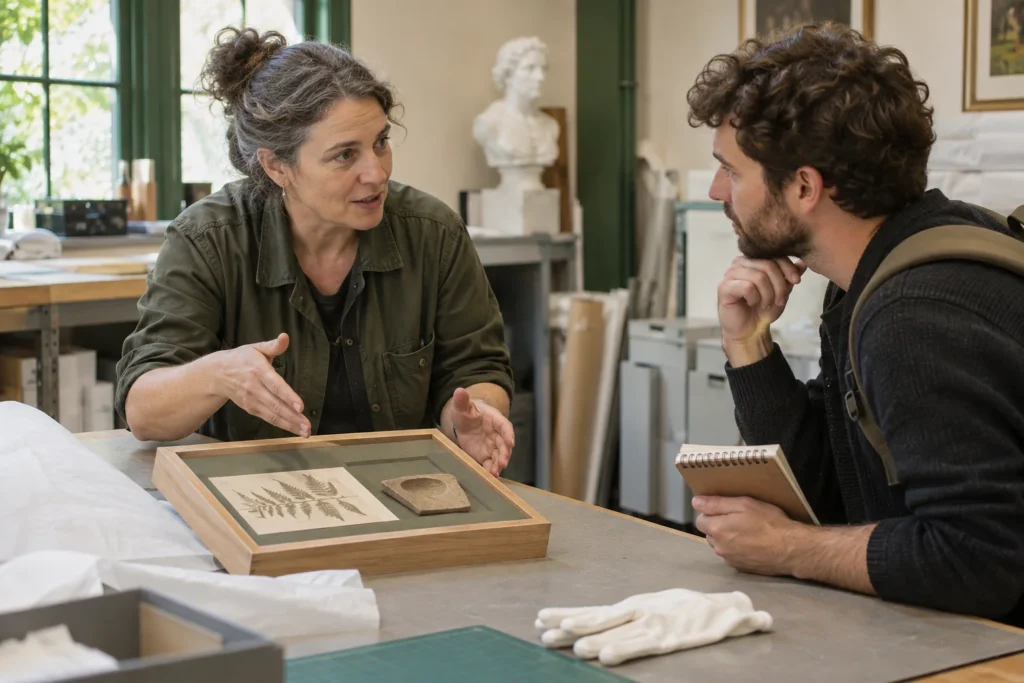
A conversation with someone doing the work can answer questions that a career profile cannot. What interrupts their day? Which tasks need the most concentration? What surprised them when they started? An informational interview gives you a chance to investigate those details before making a larger commitment.
You are asking to learn, not asking the person to find you a job. That distinction makes the request clearer and helps you keep the conversation useful. The method below is a suggested research exercise, not a guarantee of access, a referral or employment.
Decide which uncertainty you want to investigate
Start with one question that matters to your decision. Perhaps you like the idea of teaching but know little about preparation outside the classroom. Perhaps you enjoy design but want to understand client revisions. Perhaps a practical trade interests you, but you need to investigate travel between sites.
Write your current assumption and what would change your view. “I assume most of the week involves independent work; I need to understand how often priorities are changed by other people” is specific enough to guide a conversation. “Tell me everything about your career” is much harder to answer in a short meeting.
Read the available career and employer information first. Use the conversation to explore the gaps. A person can explain their own working life; they should not have to recite information you could have found on an organisation’s website.
Choose someone whose setting is relevant
Look beyond the title. A nurse in a hospital, a community service and a research setting may describe different routines. A designer employed by an agency may face a different approval process from someone working inside a manufacturer. You need to know which setting the person’s answers describe.
You might find a suitable person through an existing professional contact, an alumni service, a public careers event or a professional association. Respect the channels the person has chosen for contact. Do not seek private contact details or treat a personal account as permission to send repeated requests.
One conversation can produce useful clues. It cannot establish what every workplace in a profession is like. If the decision is important, seek another perspective from a different setting and compare what is consistent and what varies.
Make a small, honest request
A useful request says who you are, what you are researching and why this person’s experience is relevant. Ask for a short amount of time and make declining easy. The following is a fictional template to adapt, not a message sent by Career360:
“I am exploring museum exhibition work and trying to understand how projects move from planning to installation. Your role appears relevant to that question. Would you be willing to have a brief conversation at a time that suits you? I am looking for information about the work, rather than asking about vacancies. I understand if your schedule does not allow it.”
Do not attach a CV or several documents unless invited. If the person declines or does not reply, respect that. An informational conversation is voluntary, and a large number of messages does not make the research better.
Ask one written question if a call is hard to arrange
A short written exchange can be easier to fit around work, caring responsibilities or time zones. Pick one uncertainty that could change your next step. Give the person the option to answer briefly in the channel you already use together.
For example, Noor is exploring a fictional museum collections role. The advert mentions working with volunteers, and she wants to understand what that means in practice. Her note to a former colleague might say:
“I’m exploring collections work and trying to understand the amount of team coordination. In a recent ordinary week, when did you need to work directly with volunteers, and what did you do together? A sentence or two would help. Please leave out any names or collection details that aren’t public.”
If the reply says, “I set up one group session and checked its records the next day,” record the task and the setting alongside the answer. Noor can now ask the hiring manager how often the advertised role runs those sessions and who reviews the records. If nobody replies, she can put the same question to the hiring contact or use the working environments guide to record it as a question for later research.
Use questions that reveal an ordinary week
- Tasks: “Could you walk me through a recent ordinary day, without sharing confidential details?”
- Time: “Which parts take more time than people outside the role usually expect?”
- Judgement: “What decisions does someone new need help with?”
- Setting: “How do location, season or project stage change the work?”
- Learning: “Which skills became more important once you started?”
- Trade-offs: “What is rewarding, and what can be difficult to sustain?”
- Verification: “Where should I check current entry or registration requirements?”
Choose the questions relevant to your uncertainty rather than reading all of them mechanically. Follow a useful answer. If someone says the work is unpredictable, ask for a non-confidential example of how plans changed. If they say teamwork matters, ask who they work with and what they need from those people.
Do not ask for patient, pupil, customer or employee details. Avoid requests for internal documents, interview questions or unpublished business information. If the person mentions something sensitive, move back to the general work rather than pressing for detail.
Listen for the scope of each answer
Separate what happened to this person from a wider claim. “Our team usually has a planning meeting on Monday” describes their team. “Everyone in this profession works that way” needs much stronger support. Ask how the person’s experience might differ in another workplace, location or level of responsibility.
If an answer concerns pay, qualifications or professional permission, note where you need independent verification. A person’s route into a role may have been available years ago or under rules that have since changed. Their experience is valuable without being a current entry guide for you.
Ask permission before taking notes, and do not record the conversation without explicit agreement. Keep the time you requested. A simple closing question is: “What have I not asked that would help someone understand this work more realistically?”
Compare two answers before you change your plans
Suppose you need to know whether exhibition work fits a fixed evening commitment. In one fictional conversation, a museum coordinator says, “I left by five each day last week.” In another, an exhibitions technician says, “I stayed until eight twice last week.” Both answers can be accurate. The coordinator was preparing a future show. The technician was working through the final days before a public opening.
Bring the accounts onto the same footing by asking each person, “In the month before your last opening, which evenings changed, who had to stay and how much notice did they get?” Keep the role and project stage beside each answer. A coordinator’s preparation week and a technician’s installation week leave two different questions about your intended role.
Your research note could read, “I have one example of a regular preparation week and one example of late installation work. I still need to find out whether the role I’m considering covers installations and how the team schedules evening work.” Bring that question to the employer for the specific vacancy. If the answer is still unclear, leave schedule fit open in your shortlist and record whom you will ask next.
Turn the conversation into a decision
Soon afterwards, write five short notes: your original assumption, what you heard, which workplace it described, what remains uncertain and what you will check next. Keep names and private details out of any public portfolio or article unless you have permission to include them.
For example, a fictional career explorer expected museum work to be mostly solitary preparation. The conversation revealed frequent coordination with educators and installers. The useful next step is to investigate that collaborative work, not to conclude that every museum role is unsuitable.
If you send a thank-you message, mention one useful thing you learned. Do not turn it into an unrequested application or imply that the person endorsed your suitability. The value of the meeting is a clearer question and a more realistic next move.
For further context, the Government of Alberta’s alis informational-interview guidance describes conversations as a way to research occupations. Its service is based in Alberta, Canada. The questions and decision record above are Career360 editorial suggestions, not quotations from an interview or findings from a Career360 study.
Continue your research
AI-assisted Career360 editorial guide. General information for career exploration.