The work in context
Career overview
Diagnostic medical sonographers use ultrasound equipment to capture images and share technical findings with a clinical team. In the United States, the job combines time with patients and time spent checking what the images show clearly enough for the team to use. The balance varies across departments and specialties.
What the work feels like
Part of the work happens while an exam is in progress. A sonographer explains what the patient can expect, helps them get into position and checks image quality as the images appear. A later part involves organising images and passing on relevant findings to the clinician who will use them. The O*NET task profile describes both parts.
Two jobs with the same title can have different routines. The US Bureau of Labor Statistics work-environment overview describes hospital and other healthcare settings, including bedside work and possible evening, weekend or overnight shifts. Ask a department what proportion of its work is scheduled, how portable exams are shared and how much of the day is spent standing or helping move patients.
Try writing a training-lab quality note
A tutor uses a simulator to teach image review. Before the next group arrives, you need to leave a short note about two fictional practice files. There are no patients or clinical records.
- Set A: The checklist calls for three practice views. All three file names appear in the folder. When you open the second file, only the screen label is visible. You cannot assess the image.
- Set B: Two of the three practice views open and appear clear. No file is labelled as the third view. A colleague thinks an unlabelled file could be the one you need.
For each set, write one sentence stating what you could verify and one question for the tutor. Avoid using “complete” simply because three files appear to be present.
Compare your note with a worked example
Set A: “Three file names match the checklist, and I could check the contents of two. Could you review the second file with me before marking the set complete?” Set B: “I could open two of the required views. The third labelled view is missing. Can you confirm what the unlabelled file contains?” The first set has an image-access or quality question. The second has an identification question. Both need clarification before you can describe the set as complete.
If you enjoyed making that distinction, ask a programme how students learn to notice incomplete evidence and what feedback they receive on their documentation. This exercise is about communicating uncertainty in a training setting.
Check the training pathway before enrolling
The BLS entry overview describes associate degrees and postsecondary certificates among the usual routes, with supervised clinical training. Ask which specialty and campus the programme covers, who organises clinical placements and what students must already have to enter the certificate route.
The CAAHEP directory is one place to check a named programme’s accreditation. Then confirm credential eligibility separately with the credentialing organisation, and check any separate state and employer requirements. Request the exact credential and specialty named in recent vacancies.
Sources and scope. The occupational sources describe US work and training patterns. The original simulator exercise was prepared for Career360 with AI assistance. Local employers, programmes, credentialing organisations and state authorities can verify what applies to your situation.
01 / The work
Working life
Diagnostic medical sonographers explain procedures, acquire ultrasound images and review image quality. The balance of scheduled and bedside work, physical duties and shifts depends on the department and specialty.
Put your research into practice
Explore this career in practice
Use these editorial guides to investigate the work and plan your next questions. They do not establish local entry requirements or add reviewed evidence for your selected country.
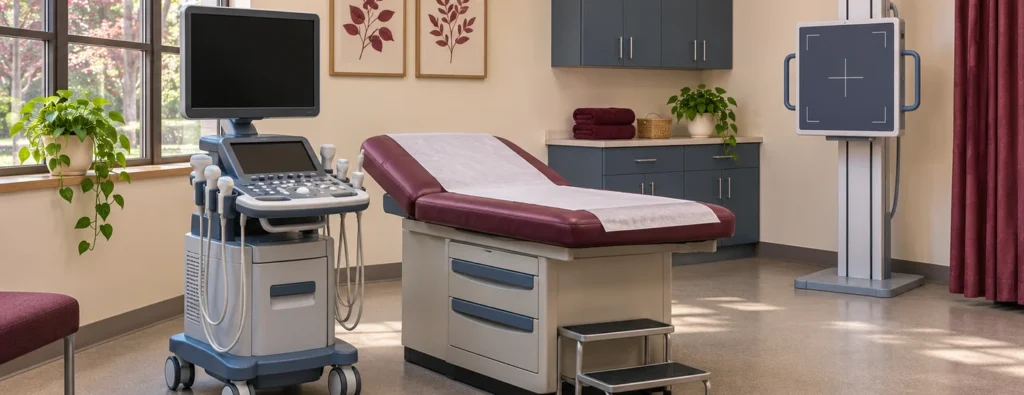
Medical imaging careers
Sonography or radiography? Compare the work and clinical placements
Compare day-to-day work in two US imaging careers, then use a fictional placement timetable to check travel, lost work hours and questions to ask before enrolling.
Read the guide : Sonography or radiography? Compare the work and clinical placements02 / Finding your route
Entry routes
US BLS describes associate degrees and postsecondary certificates among typical routes, with supervised clinical training. Check exact admissions, accreditation, certification eligibility, state requirements and shifts for the campus, specialty and employer.
The skills behind the work
Career-specific skill evidence
Explore reviewed occupation observations for your selected country. These ratings describe work, rather than your personal proficiency or legal entry requirements.
No reviewed career-specific skill observations are available for United States of America yet. Broader occupation-group skills do not establish local career coverage.
Understand the earning context
Salary evidence
United States of America · Observations describe the stated occupation and period. They are not starting salaries, experience tiers or individual predictions.
United States of America · United States (national)
U.S. wage and salary employees classified as diagnostic medical sonographers.
May 2025
| Measure | Amount |
|---|---|
| Median | USD 96,590.00 |
| 10th percentile | USD 67,820.00 |
| 90th percentile | USD 129,370.00 |
Methodology and applicability
2018 US SOC 29-2032 · May 2025 OEWS
Observation year: 2025
May 2025 U.S. national occupational employee wage estimates. Gross straight-time wages exclude overtime premiums, shift differentials and employer benefit costs. Self-employed workers are outside the OEWS population. Percentiles describe the wage distribution. Actual pay depends on working hours and role, location and employer. See https://www.bls.gov/opub/hom/oews/concepts.htm
This estimate applies to the US diagnostic medical sonographer profile and the BLS population 29-2032. It does not apply to all medical imaging occupations, other jurisdictions or an individual offer.
Applicability reference ↗A local perspective
Entry guidance where you live.
Start with the source for your country and jurisdiction. Entry routes, registration and ongoing requirements can differ.
No reviewed source overview is available here for United States of America yet. This career introduction does not establish local qualification requirements.
Prepare your next step
Learning options for this career.
Explore reviewed programmes in their stated country and jurisdiction. A learning option is not a guarantee of admission, proficiency, licensure or employment.
No reviewed career-specific learning options are available for this country on this page. Broader skill links do not establish entry-route approval.
Where this work happens
Explore reviewed industry connections for this exact career or occupation group. Each association has its own source, country and period. It does not establish demand or individual eligibility.
Showing reviewed connections for United States of America.
No current reviewed industry connections appear on this page for United States of America. This does not mean the career is limited to any one industry.
Prepare your next move
Relevant openings
No reviewed openings are available for this career in United States of America yet.