Healthcare careers
Dental assistant or dental hygienist? Compare the training
Compare dental assisting and dental hygiene in the US. Try a fictional training timetable and check clinic hours, lost pay and entry requirements.
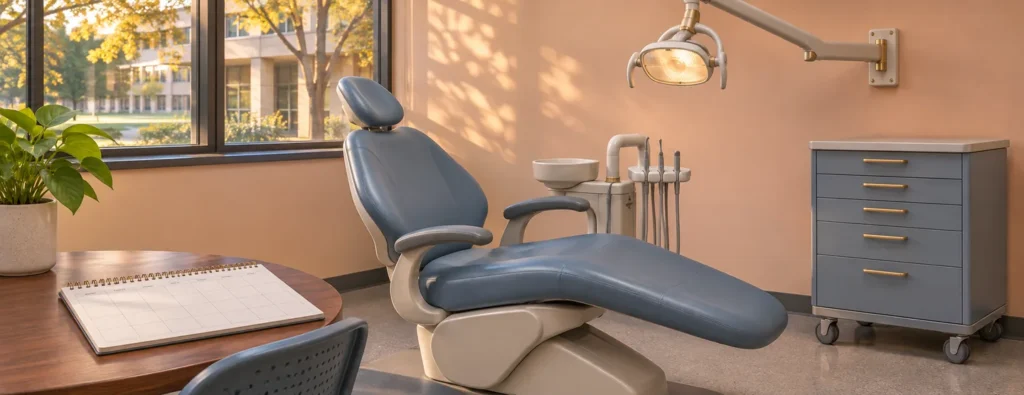
Dental assistants and dental hygienists can work in the same practice, but they train for different work. If you are weighing both, start with two questions. Which work would you like to do every week? Which route can you actually attend and afford? This guide uses US sources and a fictional example to help you answer both before you pay for training.
Compare the work you would be training to do
A dental assistant may prepare patients and equipment, support the dentist during appointments, and handle records or scheduling. The mix varies by practice. The US Bureau of Labor Statistics describes several entry routes. Some states require formal education and an exam, while on-the-job training is possible in others. Check the rules for the particular duties in the vacancy, especially when the job description mentions radiography or expanded functions.
A dental hygienist provides preventive oral care, looks for signs of oral disease, and teaches patients about oral hygiene. An associate degree in dental hygiene is the typical entry qualification in the US, and every state requires hygienists to be licensed. Clinical training is part of entering the occupation. State rules and work settings affect which duties a hygienist may perform and under what supervision.
Assisting can help you learn whether you like the pace and setting of dental practice. If you later consider hygiene, ask the specific school which previous courses it accepts and how that decision is made. Get the answer before assuming that work experience will shorten a programme.
Try a fictional training-week comparison
Sam is comparing two invented training schedules. Sam can attend in person after 5 p.m. on Mondays and Wednesdays and can commit one Saturday a month. On Tuesdays and Thursdays Sam works from noon to 5 p.m. at $18 an hour and depends on that income. The times and pay below are invented. They describe no actual school, employer or state requirement.
- Route A, dental assisting: Classes run Monday and Wednesday, 6–8 p.m. There is one Saturday lab each month. The provider says there is also a placement, but gives no hours or location.
- Route B, dental hygiene: Eight weeks of supervised clinic run Tuesday and Thursday, 1–4 p.m. Other programme hours are omitted from this exercise. Sam has no confirmed shift swaps.
Write down what fits, what clashes, and what is still unknown for each route. For Route B, estimate the difference in gross pay over the eight weeks if Sam misses only the three overlapping hours per workday and cannot make them up. Then recalculate if the employer requires Sam to take those entire five-hour shifts off. Leave travel out of the arithmetic and write it down as a separate question.
See a worked answer
Route A: The known classes and lab fit. The placement is unresolved. Sam should ask for the days, earliest start and latest finish, travel location, and whether the school assigns placements. Ask what happened in a recent intake if next term’s timetable is still provisional.
Route B: Missing three hours twice a week for eight weeks removes 48 paid hours, or $864 in gross pay. Missing two full five-hour shifts each week removes 80 hours, or $1,440. The difference is $576. Travel could make the shorter absence impractical. Sam would check clinic attendance rules with the school and shift flexibility with the employer before budgeting either amount.
Next step: Send the schedule questions to both providers. Route A remains possible while the placement is unknown. Route B needs a credible arrangement for the overlapping shifts. Neither calculation estimates tuition, admission chances or future pay.
Try a task from each role
Try the dental assistant appointment handoff and the dental hygienist patient-materials review. After each exercise, write down one part of the work you would like to observe during a practice visit.
Compare both US profiles side by side to revisit the role descriptions and see what evidence is available.
Ask three different organisations three different questions
- Ask the state dental board: For this occupation and the duties I’m considering, what education, examination, registration or licence is required? Where can I read the current requirements?
- Ask the school: What is required before admission? Which costs are outside the advertised tuition? Request a timetable, placement travel expectations, the programme’s exact credential, and any additional costs for supplies or exams.
- Ask an employer: What would an ordinary shift involve in this practice, which credentials are required at hire, and which tasks would a new hire learn under supervision?
Use the Commission on Dental Accreditation’s directory to check the exact programme and campus. Then confirm that the training satisfies the requirements for the role and state you have chosen. If you are comparing two health-care settings, use the same questions when you explore pharmacy technician work. Save the answer that would change your decision, such as a verified placement timetable, before committing to a route.
Sources and scope
- US Bureau of Labor Statistics on dental assistants covers work tasks and variation in entry and supervision.
- US Bureau of Labor Statistics on dental hygienists covers common work, education, clinical training and state licensure.
- Commission on Dental Accreditation programme finder identifies accredited programmes by discipline. Use the state dental board directory to find the authority for the state where you intend to work.
Sources checked on 22 November 2026. The exercise concerns training logistics. It does not establish anyone’s eligibility, allowed duties or earnings.
AI assistance was used to develop this guide. Career360 checked the sources, example and arithmetic.