Medical imaging careers
Sonography or radiography? Compare the work and clinical placements
Compare day-to-day work in two US imaging careers, then use a fictional placement timetable to check travel, lost work hours and questions to ask before enrolling.
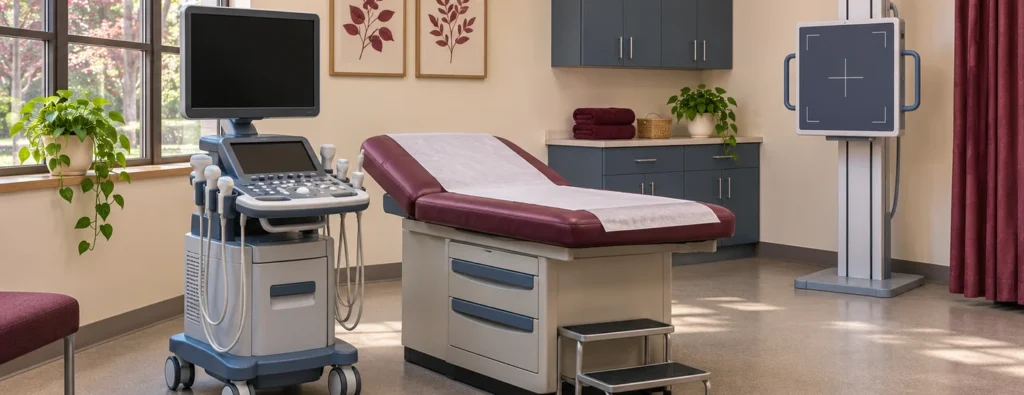
A sonography programme and a radiography programme might both advertise hands-on training in medical imaging. Their graduates can spend the working day doing different things, and the placement timetable can affect your life long before your first job. Use this US guide to compare the work and check which training route you could realistically attend.
Compare the work before comparing course titles
- Diagnostic medical sonography. Sonographers use ultrasound to capture images. They explain the exam to patients, adapt how they acquire images as they work, check the result for quality and pass findings to the clinical team. Ask a programme which specialties its students encounter and where that supervised experience takes place.
- Radiography. Radiologic technologists commonly take X-rays. The broader occupation also covers work such as CT, which may involve further training or credentials. Ask what students do during the first placement and whether advanced modalities are taught, observed or simply listed as future options.
- MRI. BLS groups MRI and radiologic technologists on one page, while describing their duties and preparation separately. If MRI is your end goal, ask what the specific programme prepares you for at graduation and which steps, if any, follow it.
Both sonography and radiography involve working with patients who may be anxious or have trouble moving, and both require careful attention to image quality. The first question for a visit or career conversation is straightforward: “What do trainees spend the most time practising here, and what do supervisors check before they let trainees do more?”
For a closer look at each US role, read the diagnostic medical sonographers profile or the radiologic technologists profile. Each includes a short work sample and questions to ask about training. Compare the two US careers side by side.
Use national pay as a starting point
In May 2025, the U.S. Bureau of Labor Statistics reported a national median annual wage of $96,590 for diagnostic medical sonographers and $80,110 for radiologic technologists and technicians. The radiography figure uses the separate occupational estimate on a page that also reports MRI wages.
These are U.S. employee wage estimates before taxes. The BLS wage measure excludes overtime premiums, shift differentials and employer benefits. When comparing local vacancies, write down the base rate, guaranteed weekly hours and any separate shift pay. Ask whether the quoted range applies to someone with your experience and the qualification you plan to earn.
Try the placement timetable test
Riley works two paid shifts a week, Tuesday and Thursday from 5 to 9 pm, and can fund a temporary reduction of up to four paid hours a week. Two fictional programmes send the following details for a 12-week placement block. Assume the travel times include the trip from the placement site to work. Give yourself five minutes to check both options before reading the worked response.
- Sonography: Tuesdays and Thursdays, 8 am to 4:15 pm. The assigned site is 60 minutes from work.
- Radiography: Wednesdays and Fridays, 9 am to 4 pm. The provider also requires six Thursday rotations during the block. Each rotation ends at 4:30 pm and the site is 45 minutes from work. Rotation dates are still pending.
- Find the earliest arrival at work on each conflicting day.
- If Riley must give up a whole shift whenever there is a clash, calculate the lost hours per block for each programme. Check the weekly limit as well as the total.
- Write one question to the programme and one to the workplace that could change your decision.
Work through the answer
Both conflicts would bring Riley to work at 5:15 pm at the earliest. In sonography, that happens twice every placement week. Giving up both shifts costs eight paid hours a week, or 96 across the block. That exceeds the weekly limit. In radiography, six affected shifts cost 24 hours across the block. A single Thursday conflict costs four hours in that week, which fits Riley’s limit. Exact rotation dates still matter, especially if the employer needs advance notice before changing shifts.
Riley could ask the radiography coordinator, “When are the six dates and placement sites confirmed, and can they change after enrolment?” A question for the employer would be, “Could I start later on these exact dates, and can we agree how I make up the time?” A 5:15 pm arrival leaves no travel buffer. If the employer can offer 5:30 starts or move shifts, the sonography option deserves a fresh calculation. The exercise compares attendance in one fictional block. Riley still needs the calendar for the rest of each programme.
Get three answers before paying a deposit
- From the programme: Ask for a recent clinical calendar, the likely placement locations, who arranges placements and how much notice students get when schedules change. Compare tuition alongside transport, required equipment and any income you expect to lose.
- From the credentialing body and state authority: Check whether graduates of the exact programme and pathway are eligible for the credential you need, and whether your intended state requires a separate licence. Verify the programme and pathway by name.
- From local employers: Read two postings for the specific modality. Write down the credentials required at hire, any training provided after hire and the actual shift expectations. Ask whether the employer routinely hires new graduates into that team.
If you’re still weighing how much direct patient contact you want, the guide to comparing nursing work and training gives you another healthcare route to investigate.
Sources and scope
The US Bureau of Labor Statistics profiles for diagnostic medical sonographers and radiologic and MRI technologists describe general US duties and training. Confirm credential eligibility, state requirements and placement details with the relevant organisations. Career360 prepared the fictional scheduling exercise with AI assistance and checked its calculations.
Open the Tasks sections in the O*NET profiles for sonography and radiologic technology. Pick one task that appears in both, such as explaining a procedure to a patient, and one that differs, such as checking an image while scanning or processing a radiograph. Take those examples to a programme visit and ask, “When would I practise each of these, who would supervise me, and how would I get feedback?”
Career360 prepared the fictional scheduling exercise with AI assistance and checked its calculations.