Occupational health & safety
Workplace safety careers: write a note the evidence supports
Try a fictional workplace-safety case. Turn a short site visit, two worker reports and a zero-injury count into a clear note, then compare US technician and specialist roles.
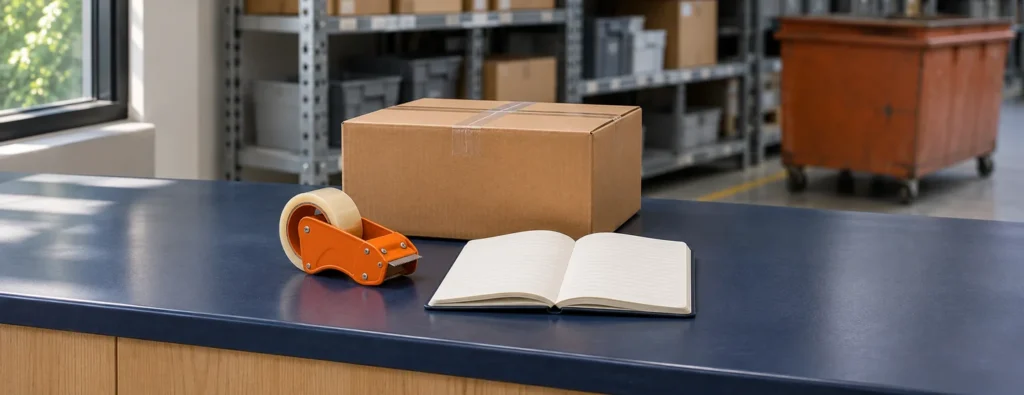
A returns team moves oversize cartons off the same counter every afternoon. Two workers say that bin changes are awkward when the counter fills up. A monthly report shows zero recorded injuries. If a manager asks you whether the work is going well, what can you say based on those three facts?
Use this fictional case to explore what occupational health and safety teams do. You’ll write a short note that distinguishes an observation from a report, identifies who is missing from the conversation, and makes a follow-up measure specific enough to check.
Compare the work behind specialist and technician titles
In its US occupational overview, the Bureau of Labor Statistics describes specialists and technicians as people who examine working conditions and help assess or improve workplace safety practices. The two roles can work together. A technician might collect measurements, document a task or follow up on changes. A specialist might interpret findings, design a programme or explain its requirements. Ask who does each part in the workplace you are considering.
The BLS describes a bachelor’s degree in a related field as typical for US specialists. For technicians, it describes at least a high school diploma and on-the-job training as typical. A job advert can ask for different credentials or experience. Ask which requirements apply from day one, and which skills the employer teaches through supervised work.
Try the returns-counter exercise
You have these four pieces of information from a fictional distribution centre:
- Direct observation. During a 15-minute afternoon visit, you saw three workers reach across the counter to move oversize cartons. You recorded the time and location.
- Worker report. Two workers said a bin change gets awkward when cartons queue up. You did not see a bin change during the visit.
- Monthly report. The summary says zero recorded injuries for the department last month. It gives no count of oversize cartons handled and says nothing about near misses.
- Missing view. The evening crew uses the same counter. Nobody from that shift has been asked how it works during their busiest period.
Write four sentences. Say what you observed, what you heard, what the report can support and what you would ask the site safety lead to verify. Then consider a manager’s proposal to add a reminder sign. What would you need to observe before deciding whether it helped?
Compare your note with a worked example
“I saw three workers reach across the returns counter to move oversize cartons during a 15-minute afternoon visit. Two workers described difficulty changing the bin during a queue, and I have yet to observe that task. Last month’s department summary records zero injuries, with no measure of how often this task was performed. Please ask the site safety lead to review the bin change with workers from both shifts during comparable busy periods.”
A sign might change what people remember while leaving the reach or the queue unchanged. During a review, ask the team to agree on an observable measure. For example, record how many reaches occur for every ten similar oversize cartons handled and note the shift, queue length and any changes to the task. If the first visit counted workers who reached, it cannot serve as the baseline for a count of reaching events. A follow-up can also check whether a change shifts the problem to another station or crew. The site team would decide what to assess, who has authority to act and which observations are appropriate.
Suppose the team runs two new checks using the same counting rule. Before the sign goes up, they record 12 reaches across 30 cartons. Afterward, they record nine reaches across 15 cartons. The raw count fell from 12 to nine. The rate rose from four to six reaches per ten cartons. Ask whether the afternoon and follow-up queues were comparable, and whether workers handled cartons of similar sizes. Two short checks can tell you what to investigate next. They cannot establish what caused the change.
OSHA’s US guidance treats observations, worker input and close calls as different sources of information. Its control guidance also calls for evaluating whether controls continue to work. The exercise is practice in describing evidence and framing questions for the responsible team.
Find out how the job works at one employer
- Pick one US technician vacancy and one specialist vacancy. Circle the verbs that tell you what you would do each week, such as observe, measure, investigate or train.
- Ask who supervises a new hire’s first site review and who decides on corrective action. Find out whether the same person checks the change after it is in place.
- Compare how much of the work takes place on the floor, at a desk, or across multiple sites. Ask whether you would need to observe work on different shifts and how often that happens.
If the evidence side of the exercise appealed to you, try the quality report comparison. It shows how a change in what gets counted can move an overall number even when individual production lines tell a different story.
Sources and scope
The BLS occupation summary and OSHA workplace guidance apply to the United States. Check employer and local requirements for any actual role or workplace. The returns-counter scenario is fictional and is designed for career exploration.
Career360 prepared the original exercise with AI assistance and reviewed the occupational context against the linked US sources on 20 November 2026.
Career360 prepared the original exercise with AI assistance and reviewed the occupational context against the linked US sources.